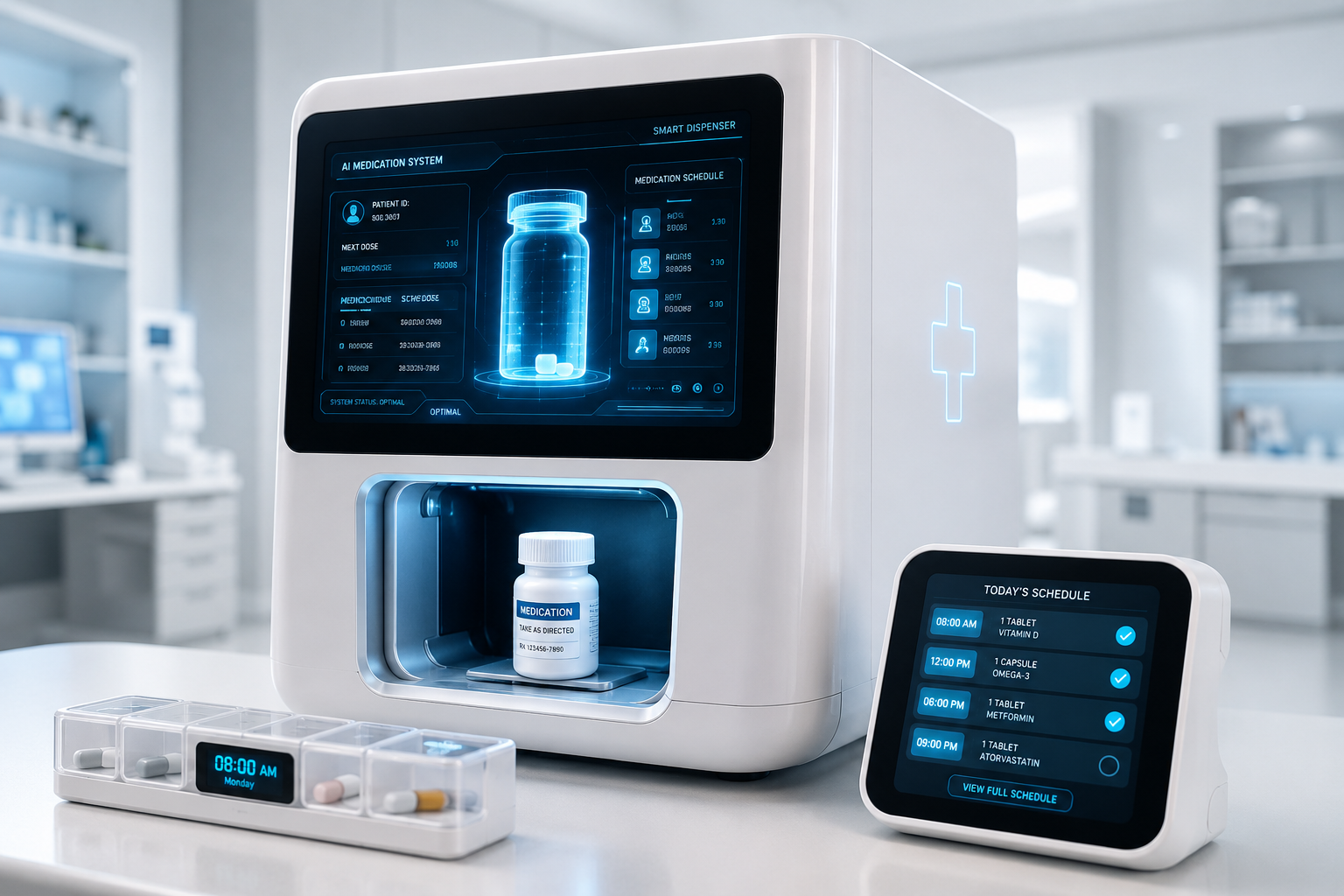
Every day, millions of people around the world forget to take their medications. Some skip doses unintentionally, while others struggle to keep up with complex multi-drug regimens. The consequences from hospital readmissions to life-threatening complications are enormous. According to the World Health Organization, poor medication adherence causes approximately 125,000 preventable deaths annually in the United States alone and costs the healthcare system over $300 billion each year.
The good news? Artificial intelligence is changing
everything.
The rise of AI-powered medicine dispensers represents
one of the most promising breakthroughs in modern healthcare. These intelligent
systems combine machine learning, computer vision, real-time monitoring, and
IoT connectivity to ensure patients take the right medicine, at the right time,
in the right dose — every single time. In this article, we explore what
AI-powered medicine dispensers are, how they work, their key benefits, and why
they are poised to transform medication management for millions of patients
worldwide.
What Is an AI-Powered Medicine Dispenser?
An AI-powered medicine dispenser is a smart automated device
that manages, organizes, and dispenses medications to patients based on
pre-programmed prescriptions and intelligent decision-making algorithms. Unlike
a traditional pill organizer or a basic alarm-based reminder, an AI dispenser
actively monitors patient behavior, adapts to changes in medication schedules,
detects errors, and communicates with caregivers and healthcare providers in
real time.
Modern systems like MediSync AI go a step
further. They integrate Generative AI for intelligent patient
interactions, Computer Vision for pill verification and
tampering detection, Agentic AI for autonomous refill
management, and IoT sensors for 24/7 environmental and usage
monitoring. The result is a complete medication ecosystem not just a box that
opens on a timer.
The Medication Adherence Crisis: Why It Matters
Before diving into the technology, it is essential to
understand why medication adherence is such a critical issue.
Non-adherence — the failure to take medications
as prescribed — is a global health epidemic. It is estimated that:
- 50%
of patients with chronic conditions do not take their medications
as directed.
- 20–30%
of prescriptions are never even filled at a pharmacy.
- Patients
with conditions like diabetes, hypertension, and heart disease face
significantly higher risks of complications when they miss doses
regularly.
- Elderly
patients managing five or more medications simultaneously are particularly
vulnerable to missed doses, double dosing, and dangerous drug
interactions.
Traditional solutions — pill organizers, handwritten notes,
phone reminders — have proven insufficient. They rely entirely on the patient's
memory and initiative. When cognitive decline, depression, or a busy lifestyle
enters the equation, these simple tools fail. This is the gap that AI-powered
medicine dispensers are designed to fill.
How an AI-Powered Medicine Dispenser Works
The intelligence behind a modern AI medicine dispenser
operates across several layers:
1. Prescription Management & Setup
Healthcare providers or caregivers input medication
schedules directly into the system via a secure web or mobile application. The
AI engine processes the prescription including drug names, dosages,
frequency, and any special instructions and programs the dispenser
accordingly. Natural Language Processing (NLP) capabilities allow the system to
parse and interpret even complex, multi-condition prescription documents.
2. Smart Dispensing with Computer Vision
When it is time to dispense medication, the device
uses computer vision algorithms to visually verify each pill
before releasing it to the patient. The system identifies the shape, color, and
size of each tablet and cross-references it against its database to confirm the
correct medication is being dispensed. If a discrepancy is detected for
example, a wrong pill in the wrong compartment the system immediately alerts
both the patient and the caregiver.
3. Real-Time Reminders and Patient Interaction
AI-powered dispensers don't just wait passively for a
patient to arrive. They actively engage the patient through audio alerts,
visual notifications, and in advanced systems like MediSync AI, through conversational
AI interfaces that can speak to the patient in natural language. If a
dose is missed, the system escalates notifications first to the patient, then
to a designated caregiver, and if necessary, to the healthcare provider.
4. Agentic AI for Autonomous Refill Management
One of the most powerful features of modern AI dispensers
is autonomous refill management. When medication stock falls below
a configurable threshold, the system's agentic AI component can automatically
generate a refill request to the pharmacy, notify the caregiver, or even
initiate a reorder through integrated pharmacy APIs all without requiring any
manual action from the patient or caregiver.
5. IoT Monitoring and Cloud Connectivity
Every interaction with the dispenser whether a successful
medication event, a missed dose, or a refill is logged and transmitted to a
secure cloud platform. Caregivers, family members, and healthcare providers can
access a live dashboard that shows real-time medication adherence data, usage
trends, and alerts. This connectivity transforms the dispenser from a
standalone device into a node within a broader patient care network.
Key Features of a Modern AI Medicine Dispenser
The best AI-powered dispensers on the market share a common
set of defining features:
- Multi-Compartment
Smart Storage — Organized pill chambers for up to 30+ days of
medication, with secure locking mechanisms to prevent unauthorized access.
- Biometric
Authentication — Fingerprint or facial recognition ensures only
the designated patient can access their medications.
- Tamper
Detection — Sensors detect if the device is opened out of
schedule or interfered with, generating immediate alerts.
- Drug
Interaction Alerts — The AI cross-checks newly added
prescriptions against existing medications and flags potential dangerous
interactions before they occur.
- Missed
Dose Reporting — Detailed adherence reports are generated for
doctor visits, enabling more informed clinical decisions.
- Emergency
Protocols — In critical situations, such as repeated missed doses
for vital medications, the system can trigger emergency caregiver
notifications or even emergency services.
- Voice
and App Control — Patients and caregivers can manage the
dispenser via a dedicated mobile app or voice commands for maximum
accessibility.
Benefits for Patients, Caregivers, and Healthcare Providers
Preview unavailable
The impact of an AI-powered medicine dispenser extends far
beyond the patient. It creates a ripple effect of benefits across the entire
care ecosystem.
For Patients
The most direct benefit is peace of mind.
Patients especially the elderly or those managing chronic conditions no
longer need to rely on memory or manual pill sorting. The system handles
everything, reducing anxiety, preventing costly errors, and improving overall
quality of life. Patients also become active participants in their own
healthcare, as the app gives them full visibility into their adherence history
and upcoming medication events.
For Family Caregivers
Caring for a loved one with a complex medication regimen is
emotionally and practically demanding. AI dispensers dramatically reduce this
burden. Caregivers receive instant notifications if a dose is missed, can
monitor adherence remotely from anywhere in the world, and no longer need to
make daily check-in calls solely to verify medication intake. This restores a
sense of normalcy and freedom while maintaining a safety net.
For Healthcare Providers
Doctors and pharmacists gain access to objective,
data-driven adherence records that paint a complete picture of patient
behavior between appointments. This leads to more informed prescribing
decisions, faster identification of non-adherence as a root cause of poor
treatment outcomes, and a reduction in avoidable emergency room visits. In
value-based care models, this data becomes a powerful tool for improving
patient outcomes and demonstrating the effectiveness of treatment plans.
Real-World Applications and Use Cases
AI-powered medicine dispensers are already being deployed
across a wide range of healthcare settings:
- Home
Care for the Elderly — Senior citizens living independently or
with minimal supervision benefit enormously from continuous, intelligent
medication management without the need for constant human oversight.
- Post-Surgical
Recovery — Patients discharged after surgery often face complex
short-term medication regimens. AI dispensers ensure complete adherence
during the critical recovery window.
- Chronic
Disease Management — Patients with diabetes, hypertension,
epilepsy, or HIV/AIDS who require lifelong medication adherence benefit
from the consistency and reliability of automated dispensing.
- Mental
Health Medication — For patients on psychiatric medications where
adherence is both critical and often challenging, AI dispensers provide a
structured, non-judgmental support system.
- Pediatric Care — Parents managing children's medications including multiple daily doses of antibiotics or specialized treatments gain confidence and accuracy through automated scheduling.
The Future: AI, Medicine, and Human-Centered Care
The integration of artificial intelligence into medication
management is not just a technological upgrade it is a paradigm shift in how
we think about patient care. As AI systems become more sophisticated, we will
see dispensers that predict non-adherence before it happens by analyzing
behavioral patterns, systems that communicate directly with electronic health
records (EHR) in real time, and devices that adapt medication schedules
dynamically based on patient-reported outcomes or biometric data from wearable
sensors.
Projects like MediSync AI are at the
forefront of this revolution. By combining machine learning, computer vision,
generative AI, agentic workflows, and IoT into a unified platform, MediSync
demonstrates what the future of personalized, intelligent healthcare looks like not a replacement for human care, but a powerful amplifier of it.
The goal was never to replace the pharmacist, the caregiver,
or the doctor. The goal is to ensure that no patient ever has to face the
consequences of a missed pill again.
Conclusion: Smarter Medication Management Starts Today
Medication adherence is one of the most solvable yet most
neglected problems in modern healthcare. The technology exists. The AI is
ready. The only thing standing between millions of patients and better health
outcomes is awareness and adoption.
An AI-powered medicine dispenser is more
than a gadget it is a lifeline for patients who depend on their medications
to stay healthy, active, and independent. Whether you are a patient managing a
chronic condition, a caregiver supporting a loved one, or a healthcare provider
looking to improve outcomes, smart dispensing technology offers a path forward.
The future of medication management is intelligent, automated, and patient-first. That future is here.